Thinking of learning French while you live in Valencia? Good news: if you speak English or Spanish, you already know thousands of French words. Still, starting from scratch raises questions: where do I start, how long will it take and do I need a school? This guide answers them step by step, with realistic timelines and tips for practising without leaving Valencia.
Is French hard to learn?
Less than it looks. English borrowed a huge number of words from French (restaurant, important, possible), and if you also speak Spanish, the grammar will feel familiar. What usually takes the most work at the start is:
- Pronunciation. French has nasal vowels (pain, vin, bon) and the French u, sounds that don’t exist in English or Spanish.
- Silent letters. In ils parlent, the -ent ending is silent, and many final consonants are too.
- Spelling. Because words aren’t written the way they sound, writing is harder than speaking.
- False friends. Librairie is a bookshop (not a library), actuellement means currently (not actually) and sensible means sensitive.
The good part: if you practise speaking from day one, your ear adjusts very quickly.
How long does it take to learn French?
It mainly depends on how many hours you put in. These are the rough figures language schools usually work with, in guided learning hours counted from zero, using the levels of the Common European Framework (CEFR):
| Level | What you can do | Approx. hours from zero |
|---|---|---|
| A1 | Introduce yourself and handle very basic situations | 60–100 |
| A2 | Talk about your daily life, go shopping, ask for information | 160–200 |
| B1 | Travel comfortably and hold a simple conversation | 350–400 |
| B2 | Study or work in French fairly fluently | 550–650 |
An example: with 3 hours of class and 2 hours of practice at home each week (5 hours in total), you would reach A2 in about 8 to 10 months and B1 in around a year and a half.
How to start from scratch: 5 steps
- Take a level test, even if you think you know nothing: you may remember more from school than you expect.
- Set a concrete goal: a trip, an Erasmus year, an official exam or a job. It will keep you consistent.
- Work on pronunciation early. A few weeks spent on the sounds saves you bad habits.
- Speak from your first class, even if it’s just short sentences.
- Listen to French every day: songs, podcasts or series with French subtitles.
Fifteen minutes of French a day beats two hours on a Saturday once a month.
Where to practise French in Valencia
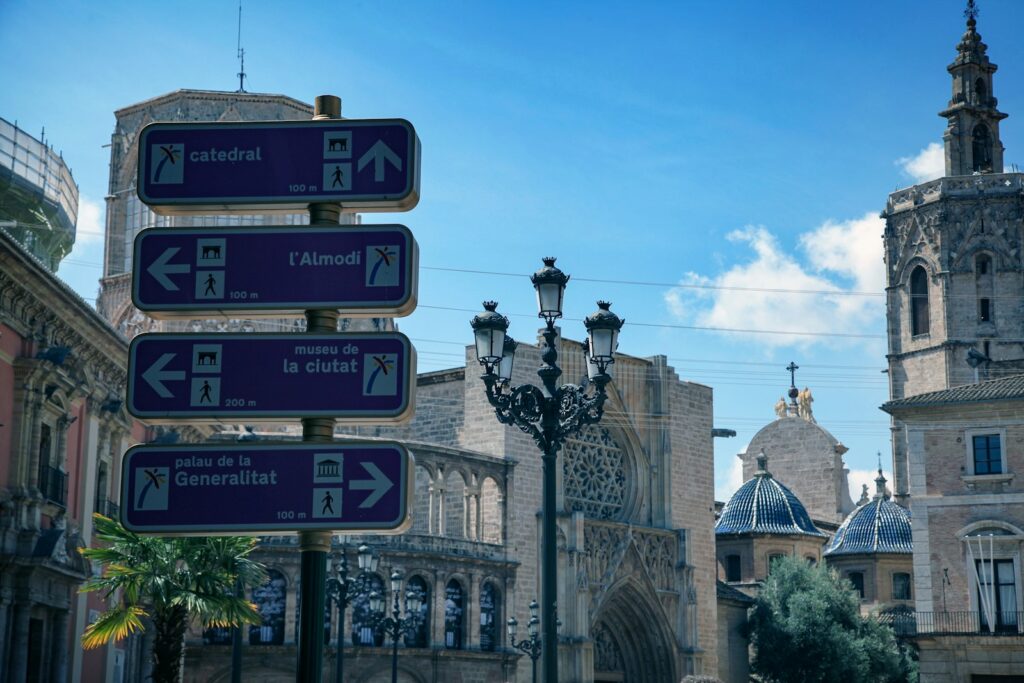
Valencia is a very international city, and there are plenty of ways to practise outside class:
- Language exchanges. Exchange meet-ups take place in bars and cafés around the city: a relaxed way to talk with French speakers who are learning Spanish.
- Original-version cinema. Some cinemas in Valencia show films in VOSE (original version with subtitles), including French ones.
- Erasmus students. Every year many students from French-speaking countries come to Valencia.
- At home: French radio and podcasts, such as RFI’s Journal en français facile, made for people learning the language.
A school or on your own?
Apps help with vocabulary, but to speak with confidence you need real conversation and someone who corrects your pronunciation. At a school you get a level-by-level plan, small groups where you speak a lot and constant feedback. If you want an official certificate later on, the next step is the DELF and DALF exams: read all about them in DELF and DALF: what they are, the levels and how to prepare. And for a lighter introduction to the language, have a look at our fun facts about French.
French lessons in Mislata
At our French school in Valencia you learn in small groups, with personal follow-up and a method that puts speaking first from the very first lessons. Your teacher will be Suzy, who teaches English and French. We are in Mislata, right next to Valencia and very close to the metro.
Frequently asked questions
Can I learn French if I’ve never studied it?
Yes. We start from A1 and, after a level test, place you in the group that suits you best.
Is French easier than Spanish for an English speaker?
Most English speakers find Spanish pronunciation easier, but French vocabulary often feels more familiar because English took so many words from French.
When will I be able to hold a basic conversation?
With regular practice, many students can manage simple conversations once they reach A2, after about 160–200 hours of learning.
Want to try before you decide? Come and see the school: your first trial class is free and without obligation.